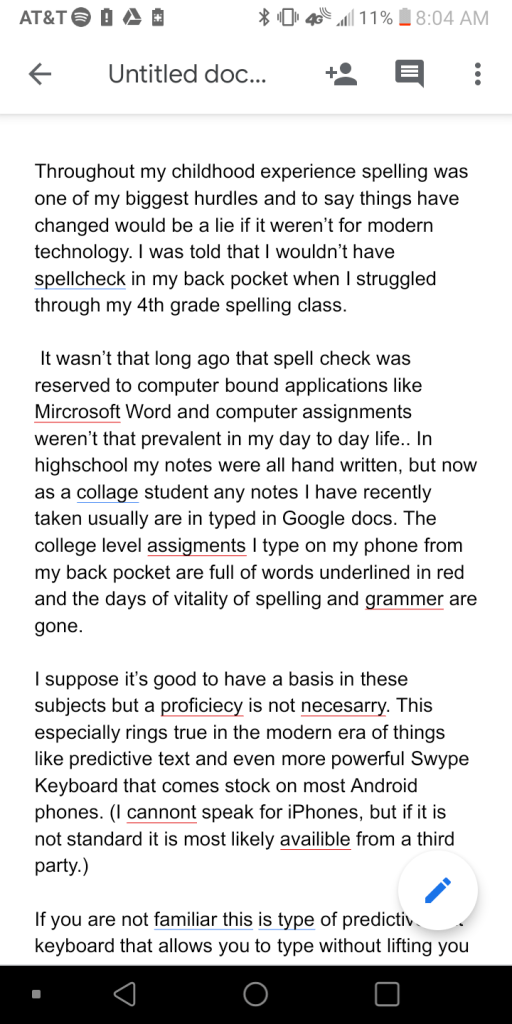
Throughout my childhood experience spelling was one of my biggest hurdles and to say things have changed would be a lie if it weren’t for modern technology. I was told that I wouldn’t have spell check in my back pocket when I struggled through my 4th grade spelling class.
It wasn’t that long ago that spell check was reserved to computer bound applications like Microsoft Word and computer assignments weren’t that prevalent in my day to day life. In high school my notes were all hand written, but now as a college student any notes I have recently taken usually are in typed in Google docs. The college level assignments I type on my phone from my back pocket are full of words underlined in red. While the days of spelling and grammar aren’t necessarily gone, this isn’t their golden era.
If you are not familiar with this type of predictive text keyboard that allows you to type without lifting you finger from the keyboard. Placing you finger on “F” and tracing a vague shape between “I” ,”N”, “G”, “E”, and “R” is sufficient. It has its own learning curve just like you have to deal with when transitioning from an analog keyboard to a touch. It allows for extremely quick one handed typing. Which has its own drawbacks as it makes it accessible to type while driving. As I wrap this up correct all the imperfections highlighted for me through this post I think it’s important to recognize this interaction between the technology we use daily and how it affects our lives even if it’s as minuscule as the effects on our writing habits.
I suppose it’s good to have a basis in these subjects but a proficiency is not necessary. This especially rings true in the modern era of things like predictive text and even more powerful Swype Keyboard that comes stock on most Android phones. (I cannot speak for iPhones, but if it is not standard it is most likely available from a third party.)
If you are not familiar with this type of predictive text keyboard that allows you to type without lifting you finger from the keyboard. Placing you finger on “F” and tracing a vague shape between “I” ,”N”, “G”, “E”, and “R” is sufficient. It has its own learning curve just like you have to deal with when transitioning from an analog keyboard to a touch. It allows for extremely quick one handed typing. Which has its own drawbacks as it makes it accessible to type while driving.
As I wrap this up correct all the imperfections highlighted for me through this post I think it’s important to recognize this interaction between the technology we use daily and how it affects our lives even if it’s as minuscule as the effects on our writing habits.
 Literature & the Internet